
Early access is open

Team chat that runs on your own servers.

Open-source team chat you host yourself. One server carries every workspace your organization needs, and one client holds every server your people work across.

Source-available (FSL 1.1). No per-seat fee, and no seat count to report.


Runs on

One host Docker Compose On the desk macOS, Windows, Linux In the pocket iOS and Android
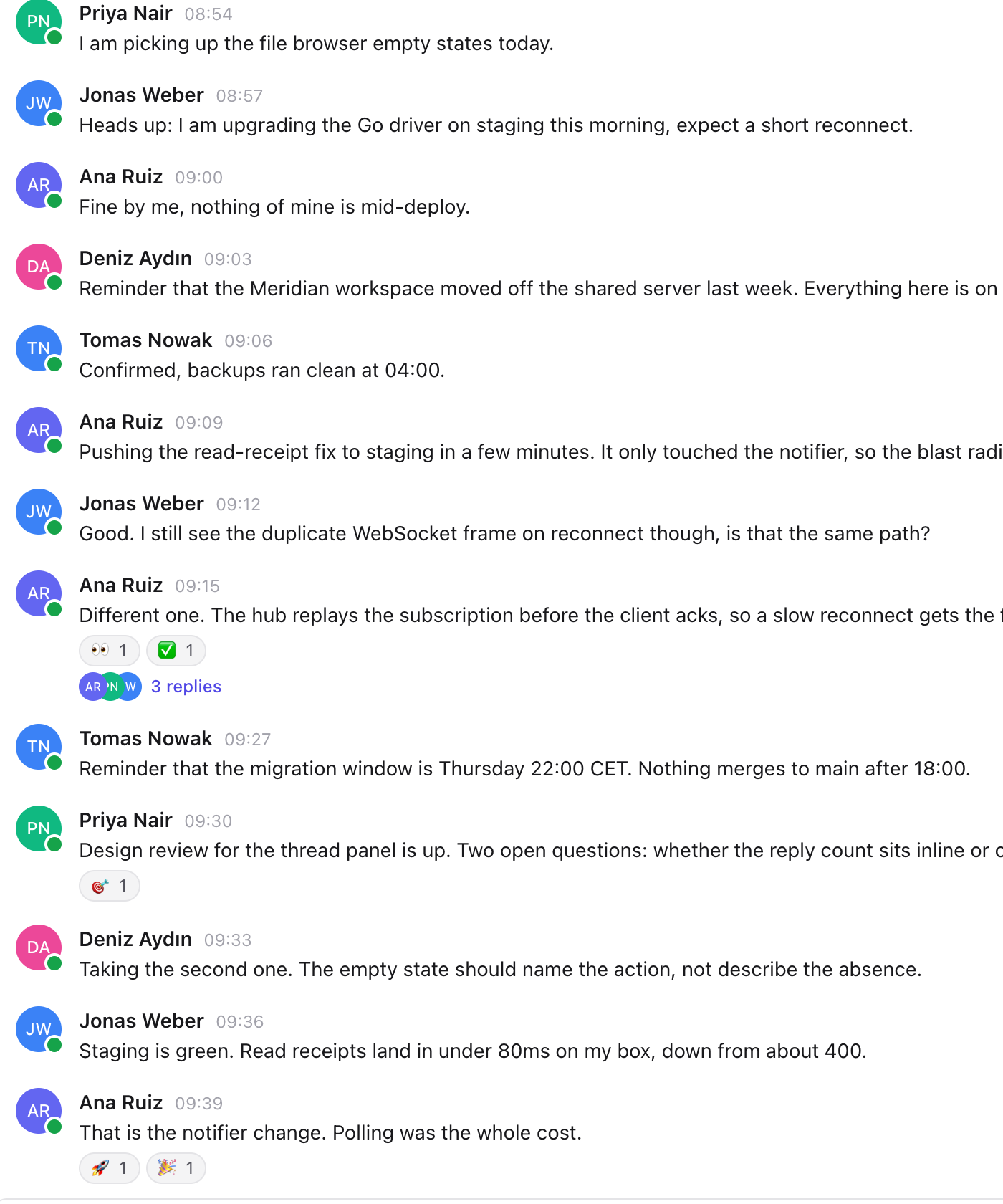
The Tulpar client showing the platform channel of a workspace: a threaded engineering conversation with reactions, presence indicators and a message composer.
  • Docker Compose on one host
  • No per-seat pricing
  • Nothing leaves your network

A Symfony API, a Go WebSocket server and a Nuxt client, on your PostgreSQL. Web and iPhone are built; what is not, is named on this page.

Why it exists

Memory is not for rent.

A chat tool you use for free walls off your archive one morning. You get to see ten thousand messages; the rest is locked. That is not a technical limit. It is a card held back for the pricing conversation.

And an organization's past is more than the space it takes up in a database. The reasoning behind a decision made under pressure, the tone of a sentence from two years ago, the note written after a mistake. How an organization thinks is kept there.

The alternatives were tried one by one. Each one produced either another version of the same wall or the same answer: the data stays on somebody else's machine. Tulpar was written for that reason.

A tamga is the oldest mark for saying what belongs to whom. It is carved into stone, and carving does not come back off.

The product

One window, every server your people are on

Three views of the same running client. Nothing here is a mockup, and nothing is a feature we intend to build.

Web, desktop and mobile. One account, the same servers; whichever you open, you carry on from the same place.

A workspace is not a server

Two different things, and you get both. One installation carries as many workspaces as your organization needs, each with its own channels, members and settings. One client then holds independent servers at the same time: your company, a customer's own installation, a community. Each server opens its own session and its own socket, and all of them sit in the same window. No second application, no second account.
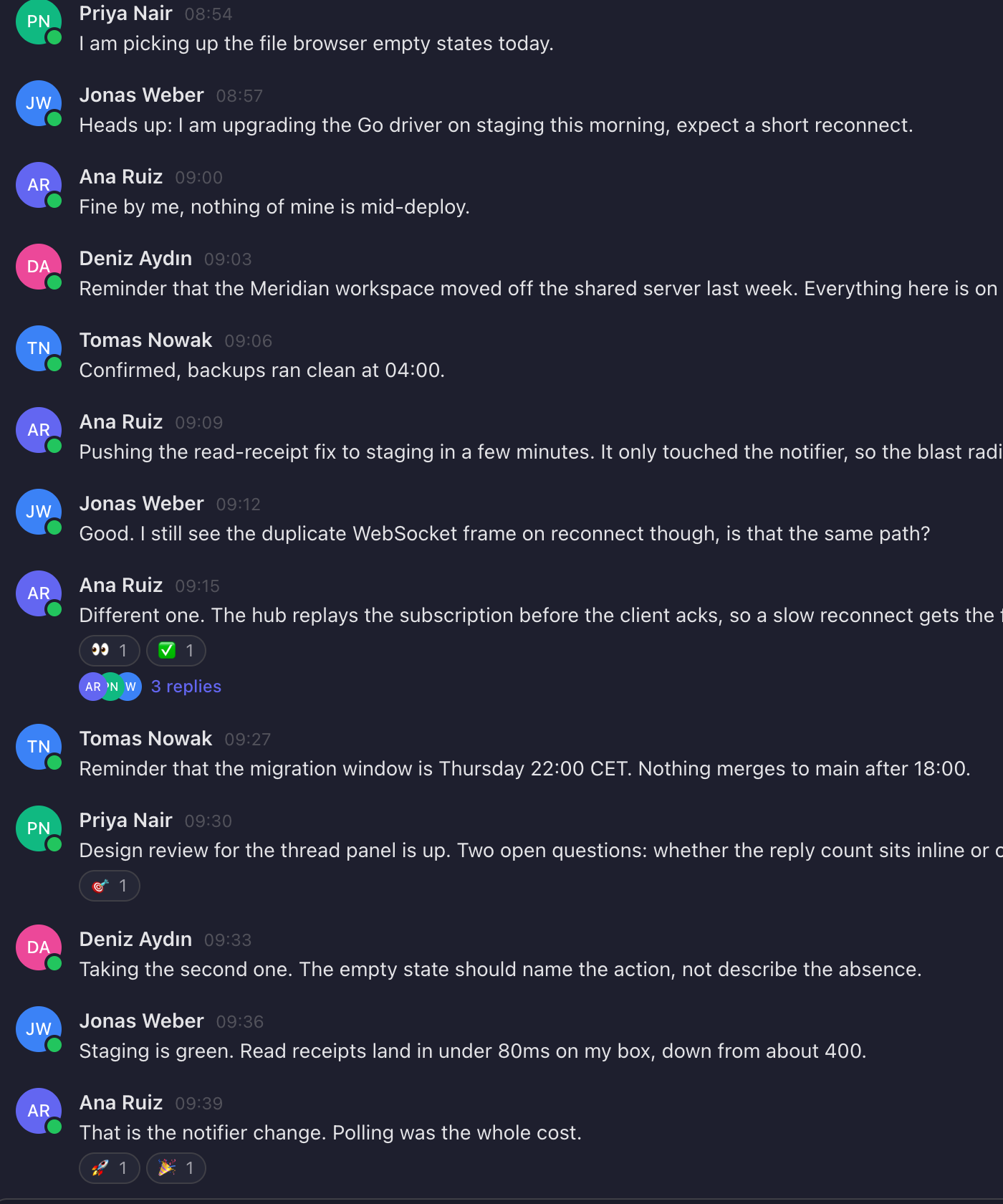
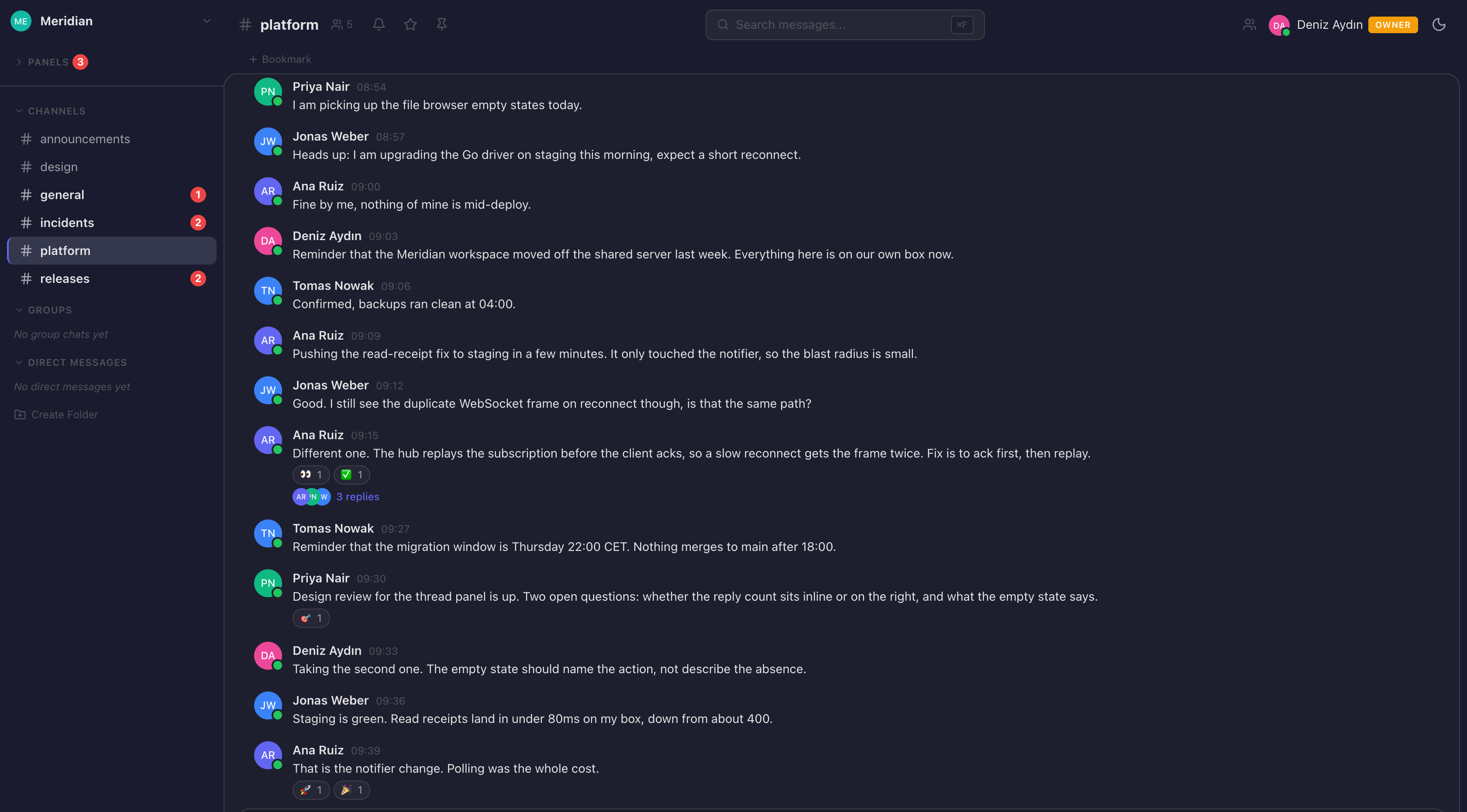
The Tulpar client showing a channel of the Meridian workspace, with the channel list, a threaded conversation and the message composer.

Threads beside the room, not over it

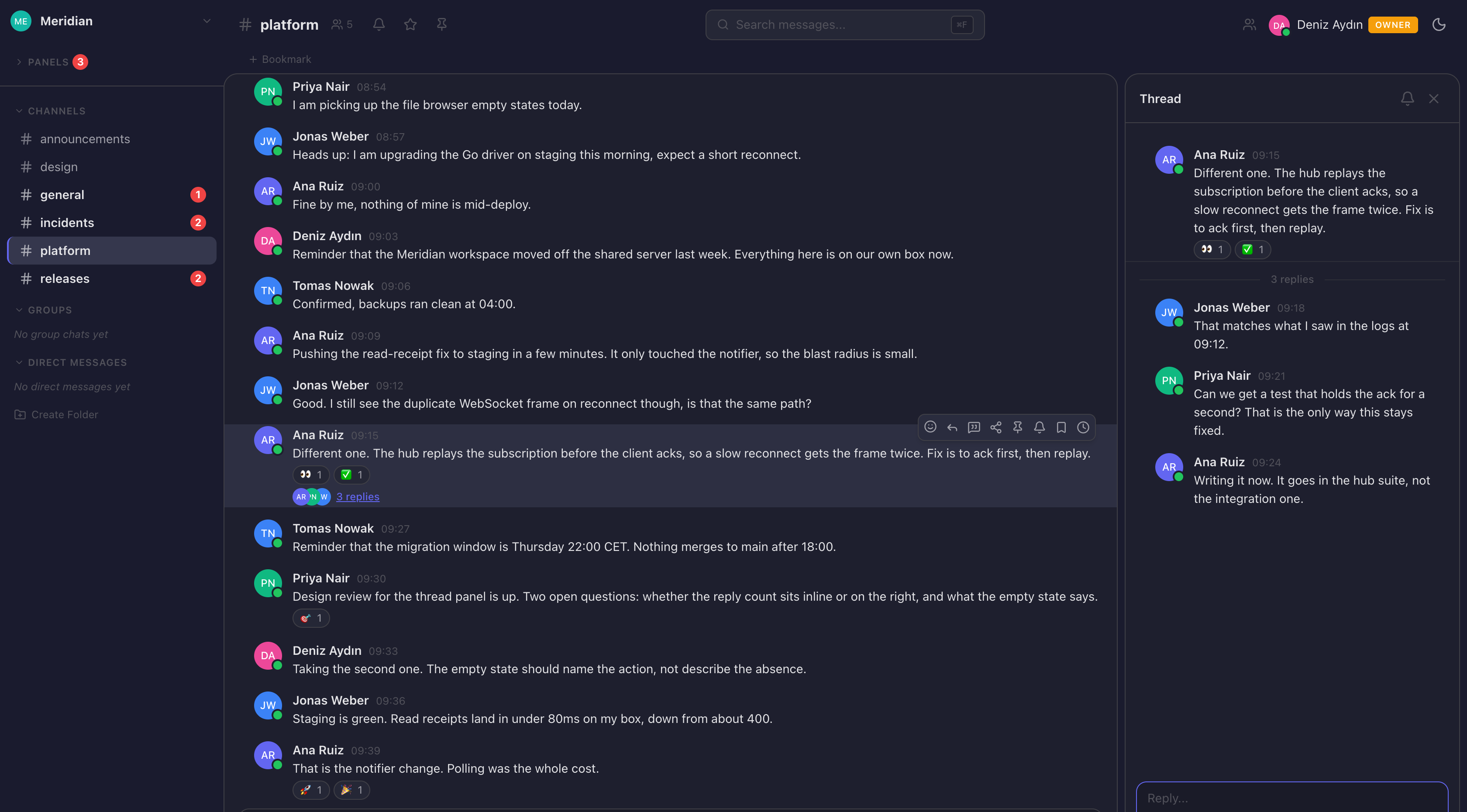
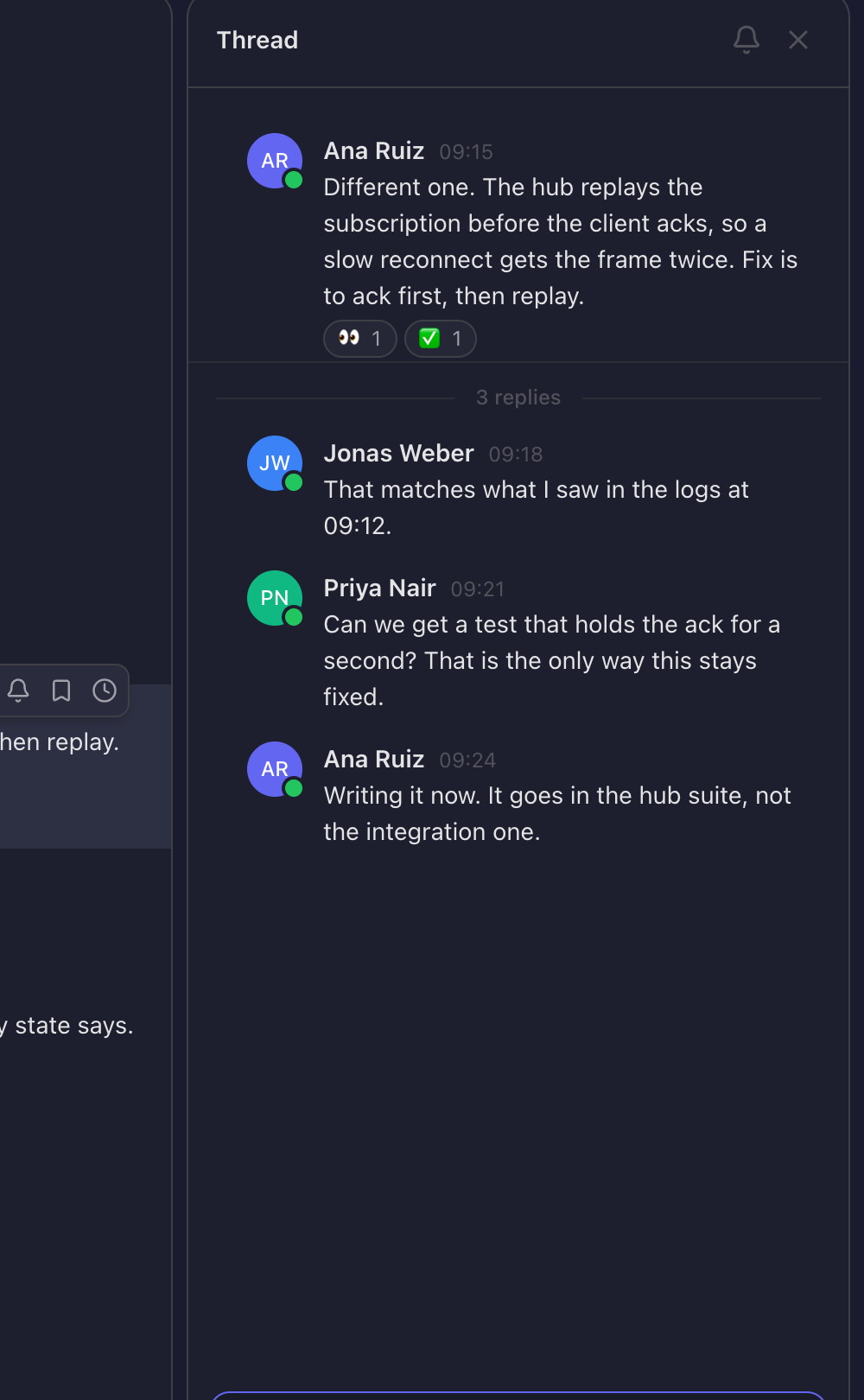
A reply count opens the thread in its own panel while the channel stays where it was. Reactions, follow, per-thread unread and the whole message toolbar come with it, and nothing you were reading moves.

The same channel with the thread panel open on the right, showing a parent message and its three replies.

You write the theme

Four palettes ship with the product, each in a light and a dark variant, and the list does not end there: you define your own theme, save it, and export it to hand to somebody else. The reading font and size are a per-person preference rather than a company decision, and the whole interface is available in English and Turkish.

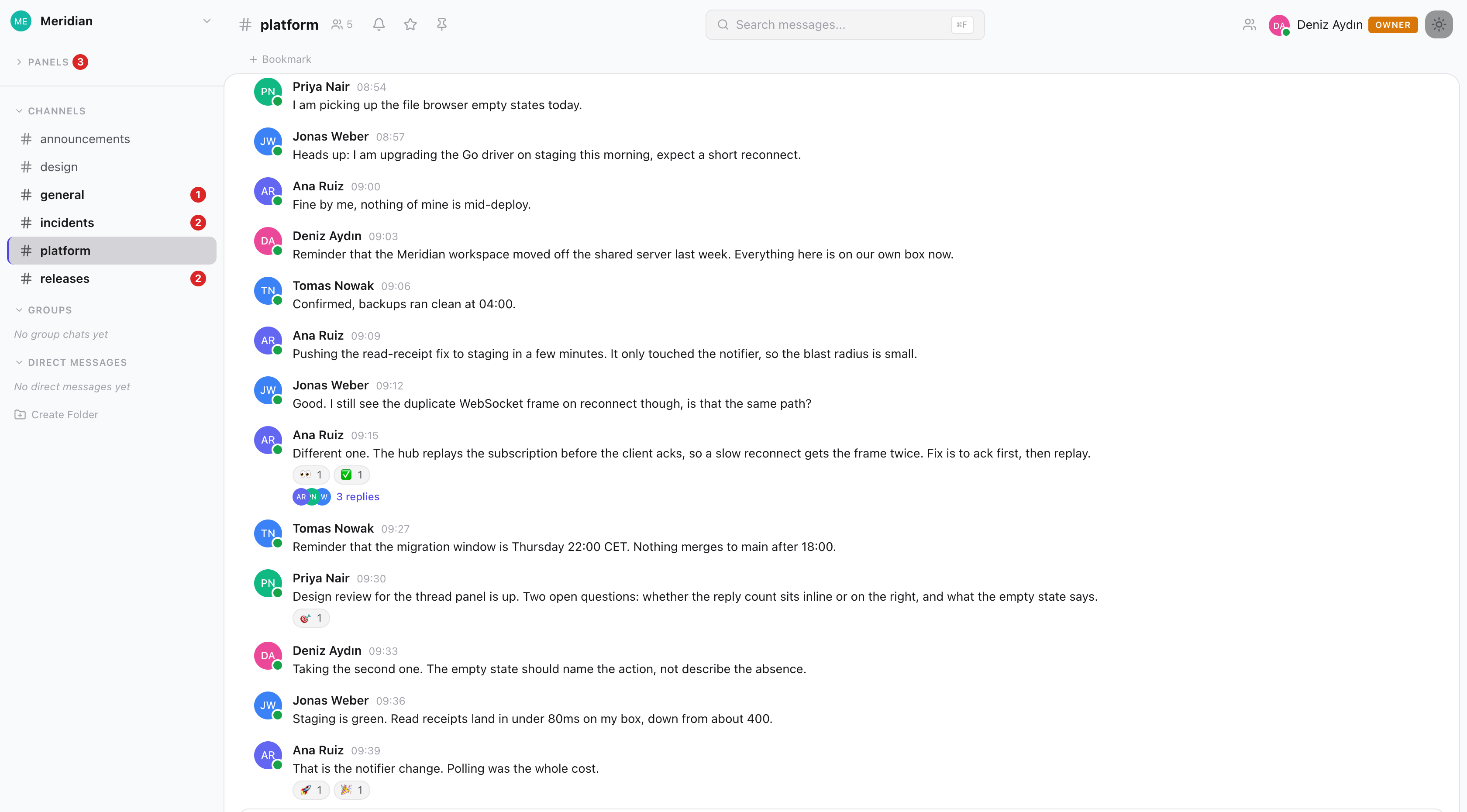
The same workspace rendered in the light theme.

The boundary

Your own infrastructure means your own data

The point is not where the software runs. It is that the conversation, the people and the files sit in a database you hold, under a key you made. Here is the whole ledger, both columns, before you think to ask for it.

Your network

  • Every message, thread and file In your PostgreSQL, on your host. There is no copy anywhere else.
  • Accounts and credentials Passwords are hashed in your database. No identity provider is required and none is contacted.
  • The signing keys The JWT keypair is generated on your machine during install and never leaves it.
  • Attachments Written to your disk by default. Object storage only if you point it at your own bucket.
  • Backups One dated archive on your host: the database dump, the app state, the keys.

Crosses the line

  • Nothing, by default There is no analytics, telemetry or crash-reporting package in the client or the server. Not disabled by a setting: not present.
  • Outbound email Through the mail service you configure, for invitations and password resets. Yours to choose, or none at all.
  • Link previews When someone posts a link, the linked site is fetched to build the card. Embeds for a few video and audio hosts load from those hosts.
  • TLS at the edge If you reach your server through a Cloudflare tunnel, TLS terminates at Cloudflare. Terminate it yourself instead and it does not.
  • An optional reading font Only if a person picks one of the alternative chat fonts. The default is the system font and fetches nothing.

A clay tablet lasted three thousand years because it sat on nobody's server.

A tamga is a mark of ownership. Carved into stone; what is carved is not taken back.

No compliance certification is claimed on this page, because none has been obtained. What is above is the architecture rather than a policy: it holds because of how the software is built, not because of a promise about how it is run.

Shipping today

All of this is already running

Not a roadmap, and not a comparison table. Every one of these is in the client you can see in the screenshots above.

Public channels Private channels Group chats Direct messages Threads Thread panel Per-thread unread Follow a message Reactions Custom emoji Mentions Mention groups
Edit Delete Quote Forward Pin Bookmark Scheduled messages Drafts Edit history Link previews Typing indicators Presence Read receipts
File upload Inline preview File browser Workspace search Command palette Channel directory People directory Channel bookmarks Do not disturb Incoming webhooks Outgoing webhooks Bot accounts Plugin hooks Health diagnostics Four palettes Your own theme Theme export Light and dark English and Turkish

Push notifications and signed plugin packages are not finished, so they are not on this page.

Plugins

Extend it without forking it

Plugins are declarative first. A manifest states what the plugin adds and what it is allowed to touch, and the core does the rest. Install one from a directory, a ZIP, or a registry you point the server at.

Slash commands
Declared in the manifest, routed by the core, answered by the plugin.
Interface slots
A plugin can put a control in the message toolbar or a tab in settings, without touching the client.
Profile fields
Add fields to a person's profile, with their own read and write endpoints.
Awards
Declare the rules; the core enforces them and owns the data and the display.
Lifecycle hooks
Run before and after an action, and cancel it outright when that is the right answer.
Permissions
Every manifest states what it wants. Anything it did not ask for, it does not get.

plugin.json

{
  "id": "com.tulpar.dice",
  "name": "Dice Roller",
  "type": "slash_command",
  "capabilities": {
    "slashCommands": [{
      "command": "dice",
      "usage": "/dice [NdN]"
    }],
    "uiExtensions": [{
      "slot": "message-toolbar",
      "icon": "dices",
      "label": "Roll dice"
    }]
  },
  "permissions": ["messages.write"]
}

A plugin that ships with the product, unedited.

What it does not do, stated here rather than discovered later: plugin PHP is not sandboxed, packages carry a checksum rather than a signature, the registry endpoints exist but the browsing screen does not yet, and a manifest asking to run a bot is rejected. Bots belong outside the request cycle, talking to the incoming webhook endpoint.

Alongside the alternatives

The same job, arranged differently

Slack and Mattermost are good software. Where they genuinely do the same thing, the row below says so; the difference is mostly in who holds the database.

Feature Tulpar Slack Mattermost
Where messages live Your PostgreSQL, your host Salesforce's cloud Your host, or their cloud
Price per person None. The software is the software Per seat, per month Free tier, paid per seat
Servers in one client Every server, in one window One workspace per window Multi-server on desktop
Source Open, and yours to change Closed Open core
Telemetry No package is present On by default On by default, can be off
Threads A panel beside the channel A panel beside the channel A panel beside the channel
Extending it A manifest, plus PHP when you need it Apps and a public API Plugins and a public API
Getting started Docker Compose on one host Sign up Docker, or sign up

On a narrow screen the table keeps all four columns and scrolls sideways rather than dropping two of them.

Pushed, not polled

Nothing on the page ever asks whether something happened. Messages, threads, mentions, reactions, read receipts, typing and presence all travel the same way, the moment they land.

  1. The API writes

    Symfony

  2. PostgreSQL announces it

    LISTEN / NOTIFY

  3. A Go server pushes

    WebSocket

  4. The client has it

    Web · iOS

Arm one

Run it yourself

Docker Compose on a single host, reachable through a tunnel. No public IP and no open ports. The installer generates the keys, runs the migrations, walks you through the admin wizard and verifies the result. Backups come out as one dated archive.

Runs on
PHP · Go · PostgreSQL
Price
No per-seat fee

Arm two

Or hand it to us

Tulpar Enterprise is the same software with the work attached: deployment on your infrastructure, migration off whatever you are running today, support with a name on it, and the integrations your organization already depends on.

Includes
Migration · Support
Same software
No features held back

FAQ

The questions people ask first

What it takes to run, what leaves the building, and what is not finished yet.

Early access

Get on the early access list

Tulpar opens in waves. Tell us where you would run it and what you are running today, and we will get in touch before the first one.

One email, written by a person. It does not pass through a third-party form service; where it lands is set out on the privacy page.

We open repository access to this account.

Which one are you after